
Tower Hill: A History Written in Country, Fire and Water |
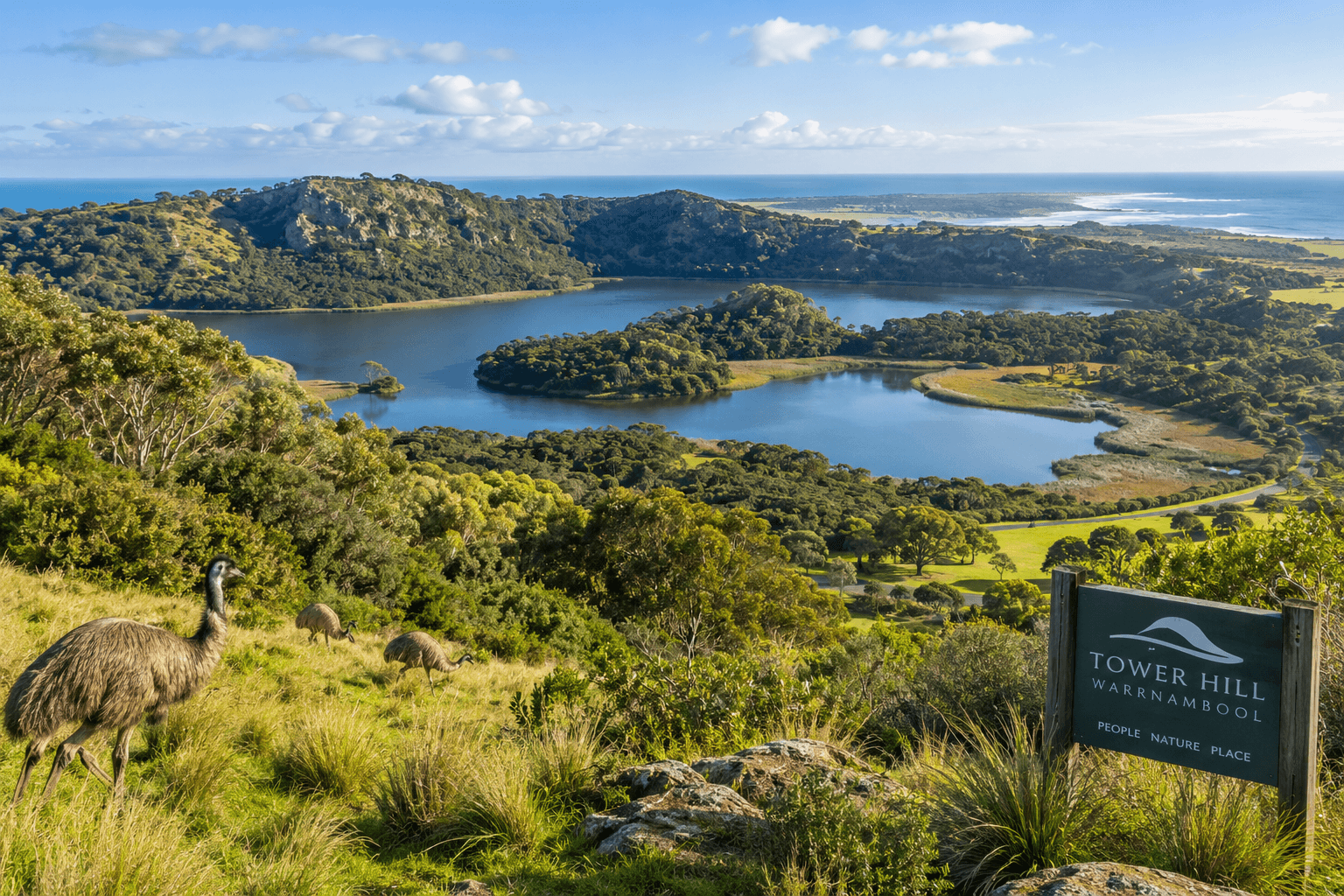
At first glance, Tower Hill looks like a peaceful landscape of green hills, lakes, wetlands and native wildlife. Emus move through the grass, trees cover the volcanic slopes, and the water sits quietly inside the crater. But Tower Hill is far more than a scenic place near Warrnambool.
Its history reaches deep into the geological past and continues through thousands of years of Gunditjmara connection to Country, European exploration and settlement, changing attitudes to the environment, and the modern effort to protect its natural and cultural heritage.
Tower Hill is a place where the history of the land and the history of people cannot easily be separated.
A Landscape Born From Volcanic FireThe first chapter of Tower Hill's story began long before humans lived in the region.
Tower Hill is a volcanic landscape. Its distinctive hills, crater, lakes and surrounding terrain were created by volcanic activity.
What now appears as a calm green basin was once shaped by powerful geological forces.
The volcanic character of the landscape remains one of its defining features today. The crater-like formation, waterways, islands, wooded slopes and rocky areas give Tower Hill a landscape unlike the ordinary farmland surrounding much of western Victoria.
The volcano is now dormant, but its presence is written across the land. That is why looking across Tower Hill is, in a sense, looking at geological history.
Gunditjmara Country
The human history of Tower Hill is much older than the arrival of Europeans.
Tower Hill is part of the traditional country of the Gunditjmara people. Around Warrnambool and the wider south-west Victorian region, Gunditjmara people have maintained a deep connection with land, waterways, coast and wildlife for thousands of years.
That connection is cultural as well as physical.
A country is not simply a piece of land on a map. It encompasses relationships between people, animals, plants, waterways, stories, knowledge and place.
The uploaded Warrnambool material describes the Gunditjmara as the Traditional Owners of the land, rivers and sea around Warrnambool and highlights their strong connection to water, wildlife and Country.
This matters when telling the history of Tower Hill. A story that begins with Europeans arriving in the nineteenth century leaves out thousands of years of human history.
Before European Settlement
For generations before European settlement, the Tower Hill landscape was part of a living cultural environment.
The wetlands and waterways provided habitat for wildlife, while the surrounding country offered resources and places connected to Gunditjmara knowledge and cultural practice.
The landscape that visitors see today is therefore not simply "untouched nature". It is a country with a long human history.
This is one of the most important ideas to carry into any modern understanding of Tower Hill: Aboriginal history is not a short introduction before the "real" history begins. It is fundamental to the story of the place.
European Exploration
European exploration of the south-west Victorian coast began in the late eighteenth century.
The uploaded Warrnambool history material identifies 27 December 1797 as the date when explorer George Bass sailed past the coast.
European exploration did not immediately transform Tower Hill. But it marked the beginning of a period in which European maps, journeys and settlement would increasingly reshape the region.
During the nineteenth century, Europeans began establishing farms and settlements across south-west Victoria.
The Warrnambool Region Changes
The development of Warrnambool and the surrounding district brought a new chapter to Tower Hill's history.
The uploaded material identifies the 1830s as an important period of European settlement around Warrnambool and records the arrival of settlers at the Hopkins River. By the 1840s, more settlers were arriving, with farming, fishing and whaling becoming important activities.
Warrnambool was officially declared a township in 1854.
As the town and surrounding agricultural district developed, the landscape around Tower Hill was increasingly connected to European farming and settlement. This period changed the relationship between people and the environment.
Native vegetation was cleared in many parts of the region. Introduced animals and plants altered ecosystems. Land was increasingly valued for agriculture and settlement.
Tower Hill's later conservation story has to be understood against this background.
From Working Landscape to Protected Landscape
The nineteenth and early twentieth centuries were a period of major change across the Warrnambool district.
Wool, timber, shipping, farming and other industries helped the region grow. The Warrnambool port became an important centre of trade, particularly during the nineteenth century. Tower Hill, however, retained something different.
Its unusual volcanic landscape, lakes, wildlife and scenery made it significant not only as land but also as a place of natural interest.
The exact dates and stages of Tower Hill's reservation and later conservation history should be checked against Victorian government and Parks Victoria heritage records before publication. [CHECK: official reserve/protection dates and major management milestones.]
The Return of Native Wildlife
One of the most recognisable features of Tower Hill today is its wildlife.
Visitors can encounter native animals and birds across the reserve, including emus. The Tower Hill landscape material repeatedly presents emus moving through the grasslands and highlights the area's importance as habitat for native wildlife.
But today's wildlife landscape is not simply the result of nature being left alone. It reflects decades of changing approaches to land management, habitat protection and ecological restoration. The modern Tower Hill story is therefore partly a story of trying to repair relationships between people and the environment.
A Deeper Cultural Story
Modern interpretations of Tower Hill increasingly place its Aboriginal heritage alongside its geological and ecological significance. That approach produces a richer understanding of the landscape.
The volcanic crater explains how the physical land was formed. Gunditjmara history explains the enduring cultural relationship with the country.
European settlement explains many of the changes that followed. Conservation explains the effort to protect what remains and restore what has been damaged. Wildlife connects all of these stories together. The result is a place with several layers of history visible at once.
Tower Hill Today
Today, Tower Hill is experienced as a natural and cultural destination near Warrnambool. Its landscape includes green volcanic hills, lakes and wetlands, woodland, grasslands, rocky formations and native wildlife.
For visitors, it can be an easy place to photograph, walk through and enjoy. But the scenery tells only part of the story.
The hills are evidence of ancient volcanic activity. The waterways and wildlife form part of a living ecosystem. The country carries the continuing connection and knowledge of the Gunditjmara people.
And the landscape also carries the consequences of European settlement and the later recognition that places like Tower Hill need protection.
Why Tower Hill's History Matters
The most interesting thing about Tower Hill may be that its history does not belong to one period. It is not simply a volcanic story.
It is not simply an Aboriginal story. It is not simply a European settlement story.
And it is not simply a conservation story.
It is all of these at once. The landscape we see today is the result of immense geological forces, thousands of years of Aboriginal connection to Country, more recent European settlement and continuing efforts to protect the environment.
That makes Tower Hill more than a beautiful place outside Warrnambool.
It is a record of change. Walk across its hills and you are walking through geological history. Look across its wetlands and you are looking at living habitat. Learn about its Gunditjmara heritage, and you encounter a cultural history far older than the town nearby.
Tower Hill's greatest story is therefore not just what happened here in the past.
It is how the land, people and wildlife continue to shape one another today. |
0 Comments
Join the conversation
Be the first to comment
Share your thoughts above.